Specialists from the CAMP Alatoo PF have joined the author team of a major study titled "Nature-Based Solutions in Mountains: Assessing the Potential of Nature-Based Solutions for Disaster Risk Reduction in Central Asia and South Caucasus."
The study was conducted under the auspices of the World Bank and the Global Facility for Disaster Reduction and Recovery (GFDRR), with support from the Governments of Austria and Switzerland. International experts from organizations such as RESALLIENCE, Sponge Collaborative, and ESAC also contributed to the development of the publication.
The study was driven by the urgent need to mitigate disaster risks caused by climate change and human activities across Kyrgyzstan Kazakhstan, Uzbekistan, Tajikistan Armenia and Georgia. In the mountain regions of these countries, the increasing frequency of mudflows, landslides, floods, droughts, and soil erosion causes billions of dollars in economic damage annually and threatens the safety of millions of people.
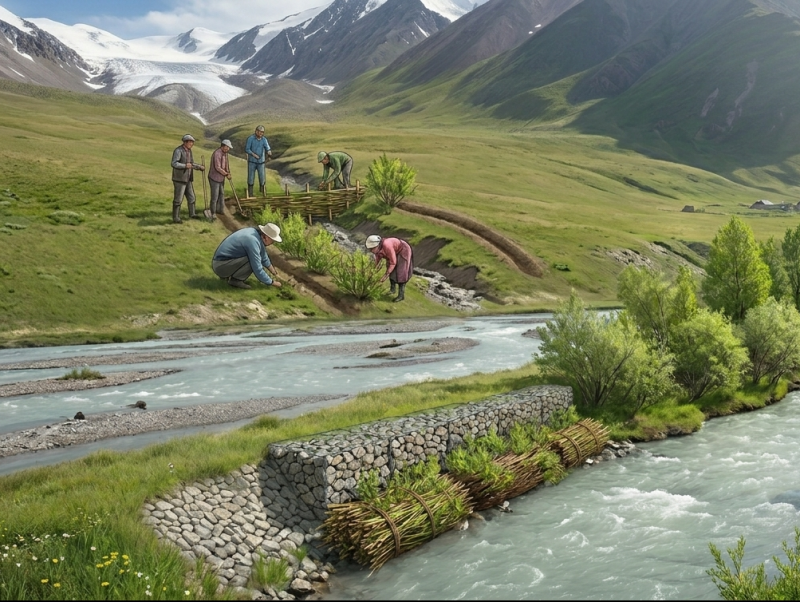
Traditional "gray" infrastructure (such as concrete dams, mudflow diversion channels, and retaining walls) requires significant investment and maintenance, yet it often struggles to cope with accelerating climate anomalies. Consequently, the authors of the publication advocate for the active integration and utilization of solutions that leverage the protective properties of ecosystems. The publication serves as a practical guide and an investment tool for landscape planning of "green" technologies.
It compiles and describes 28 practices, including forest restoration on steep slopes, phytoremediation, sustainable rangeland management, the application of bioengineering structures, and much more. Additionally, the report presents an vulnerability assessment of mountain regions in Central Asia and the Caucasus to climate threats and natural hazards, outlines approaches for selecting protective measures for each ecosystem, and features practical case studies of solution applications across 8 landscapes, including Lake Issyk-Kul, the Fergana Valley, and the high-altitude zones of Almaty.
This publication is intended to become a go-to reference guide for government agencies, local communities, and international donors. It provides clear mechanisms for embedding "green" technologies into various disaster risk reduction strategies.

Итоги пастбищного сезона 2018 года были подведены на очередном заседании районной пастбищной комиссии (РПК).
More
The development of the unified method, "Monitoring Pastures at the Local Level," is nearing completion.
More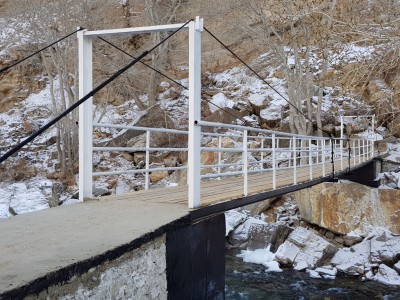
Четыре новых моста построены в 2018 году в Кыргызстане при поддержке ОФ “CAMP Алатоо” и Швейцарской ассоциации “Памирские...
More