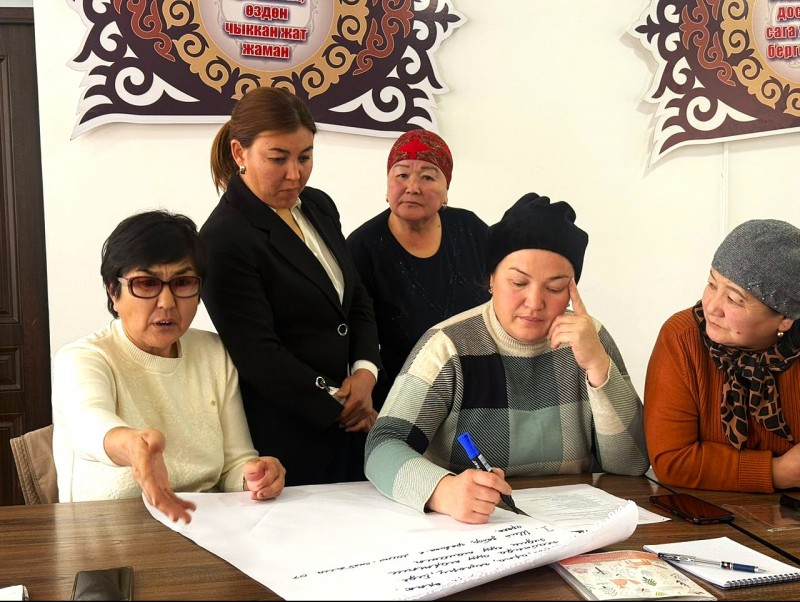
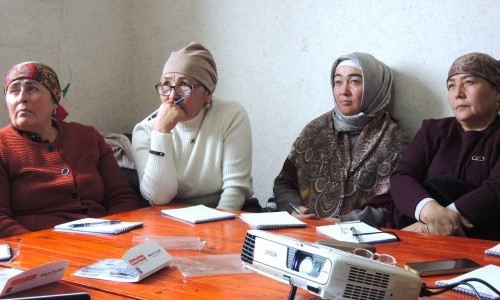
Specialists from САМР Alatoo PF have delivered a series of training sessions on introducing highly efficient, cost-effective irrigation methods, along with practical guidance on preparing and managing grant applications. The trainings were organized for 10 aiyl aimaks across Osh, Jalal-Abad, and Batken regions, reaching around 170 local residents.
Women made up the majority of participants, including women farmers, single mothers, and representatives of vulnerable groups. The selection process prioritized strengthening women’s leadership, enhancing their capacity for climate adaptation and water resource management, promoting their participation in peacebuilding processes, and equipping them with grant-writing skills.
The primary goal of the trainings was to introduce communities to smart irrigation solutions—low-cost, efficient, and climate-resilient—and enable participants to apply them in practice. Equally important was building practical skills in grant proposal development and project management.
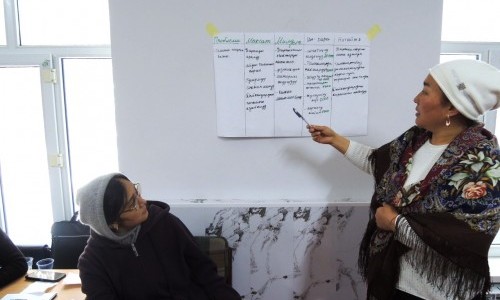
The modular training combined technical and hands-on components. Through real-life examples, participants explored affordable water-saving irrigation technologies applicable to their villages and completed the full grant management cycle—from developing a project concept to budgeting, procurement planning, and reporting requirements.
As a result of the practical work, participants developed 30 grant proposals addressing real water supply challenges and climate pressures in their communities. The initiatives focus on collective rehabilitation of irrigation canals and ditches, installation of drip and gravity-fed irrigation systems, and construction of water storage basins.
Project specialists particularly highlighted the strong engagement of participants in Batken region, where most proposals focused on introducing household-level drip irrigation as the most accessible and efficient solution under conditions of water scarcity.
A comparative analysis conducted before and after the trainings revealed significant progress. Prior to the sessions, over 46% of respondents relied on canals and open ditches for irrigation, while fewer than 5% used drip systems. Meanwhile, 57% regularly faced irrigation water shortages, directly affecting crop yields, household incomes, and often creating tensions over water allocation.
After the trainings, knowledge levels tripled—from 14.9 to 44 points. Participants gained a stronger understanding of rational water use, smart irrigation principles, and practical ways to reduce water losses in local conditions. Many who had previously only heard of water-saving technologies are now able to calculate water needs, design irrigation schemes, and apply affordable solutions independently.
Another key outcome was the leadership demonstrated by women, who emerged as initiators of project ideas and leaders of community groups. In many villages, women coordinated project development while involving men in technical implementation. This approach contributes to reducing tensions over water distribution, strengthening dialogue between villages, and enhancing social cohesion at the community level. Project experts also emphasized the high potential of women as agents of climate adaptation, a resource that can support scaling the initiative to other regions.
The trainings were conducted under the project “Women of Ferghana Valley at the Frontlines of Climate Resilience, Adaptation and Peace.” implemented with the support of the UNDP and the United Nations Peacebuilding Fund.
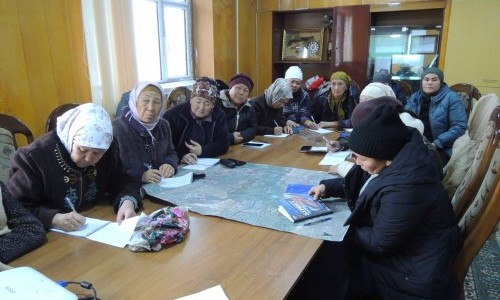

Итоги пастбищного сезона 2018 года были подведены на очередном заседании районной пастбищной комиссии (РПК).
More
The development of the unified method, "Monitoring Pastures at the Local Level," is nearing completion.
More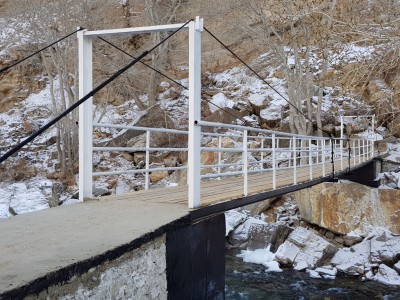
Четыре новых моста построены в 2018 году в Кыргызстане при поддержке ОФ “CAMP Алатоо” и Швейцарской ассоциации “Памирские...
More