Climate change, poaching, and the degradation of natural resources demand new approaches to the management of protected areas (PAs). To make effective management decisions during the development of management plans, it is essential to conduct timely assessments of threats, climate risks, and the vulnerability of ecosystems and species. Within the framework of the "Climate Change Adaptation for Migratory Animals in Central Asia" (CAMCA) project, international approaches and tools have been adapted for application in developing climate-smart PA management plans. These tools allow for the identification of conservation priorities, assessment of the climate vulnerability of territories and individual species, integration of local community knowledge, and evaluation of PA management effectiveness. Their comprehensive application facilitates the development of science-based management plans and the definition of effective biodiversity conservation measures under changing climate conditions.
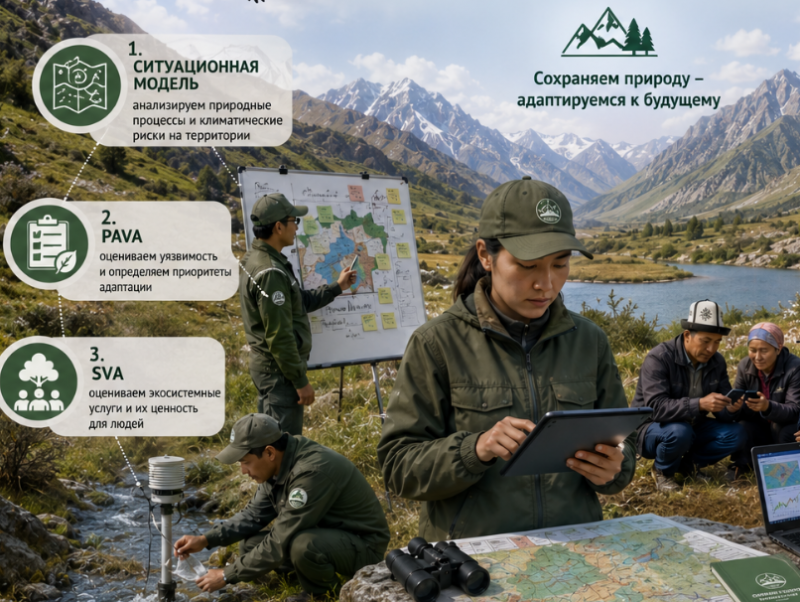
Situation Model
The Situation Model is a strategic analysis tool that helps identify key ecosystems and species, detect main threats, establish their root causes, and determine mitigation measures. It allows for tracing the interconnections between conservation targets, threats, and management decisions, which helps formulate well-founded conservation activities to be included in the PA management plan.
Protected Area Climate Vulnerability Assessment Using the PAVA Tool
The PAVA (Protected Area Vulnerability Assessment) tool is developed based on Microsoft Excel and is designed for the comprehensive analysis of PA climate vulnerability. It allows for the assessment of a territory's exposure to climate change, ecosystem sensitivity, adaptive capacity, and additional threats. Based on the entered data, the system automatically generates visual charts and diagrams, significantly easing the vulnerability analysis and the identification of priority adaptation measures. Special attention is given to assessing adaptive capacity — the ability of PA staff to respond effectively to climate challenges using available knowledge, experience, and resources. An online version of the PAVA tool is also available in English.
Species Climate Vulnerability Assessment Using the SVA Tool
The SVA (Species Vulnerability Assessment) tool is designed for the expert assessment of the climate vulnerability of individual animal and plant species. It enables a comprehensive evaluation of how climate change might affect a specific species, taking into account its biological characteristics, population status, habitat requirements, capacity to adapt to changing climate conditions, as well as existing natural and anthropogenic threats. The assessment results are used to determine priority measures for species conservation and complement the results of the Protected Area Vulnerability Assessment (PAVA), ensuring an integrated approach to the development of the PA management plan.
Climate Data Collection and Analysis Using the Climate Crowd Approach
Most PAs border the territories of local municipalities (ayyl aimaks), whose residents observe environmental changes daily and actively utilize natural resources. The Climate Crowd approach, developed by the World Wildlife Fund (WWF), allows for leveraging the knowledge and observations of local communities to identify climate changes, assess their impacts on biodiversity, and determine potential adaptation measures. The gathered data effectively complements scientific information and helps incorporate the interests and opinions of the local population when developing or updating PA management plans.
Protected Area Management Effectiveness Evaluation Using the IBEX Tool
The IBEX (Improvement Benchmarking and Evaluation Index) tool is developed based on Microsoft Excel and is designed for the comprehensive evaluation of protected area management effectiveness. It helps the PA administration objectively assess the quality of the management system, identify strengths and weaknesses, and determine existing limitations and priority areas for improvement.
Based on the entered data, the tool automatically calculates efficiency indicators and generates a visual radar chart reflecting the level of implementation of the main management components. The obtained results can be used to update the management plan, determine priority activities, allocate resources, and improve overall PA performance.
You can view all 5 tools in an infographic format and download practical materials via the following.
Image generated by AI.

Итоги пастбищного сезона 2018 года были подведены на очередном заседании районной пастбищной комиссии (РПК).
More
The development of the unified method, "Monitoring Pastures at the Local Level," is nearing completion.
More
Четыре новых моста построены в 2018 году в Кыргызстане при поддержке ОФ “CAMP Алатоо” и Швейцарской ассоциации “Памирские...
More