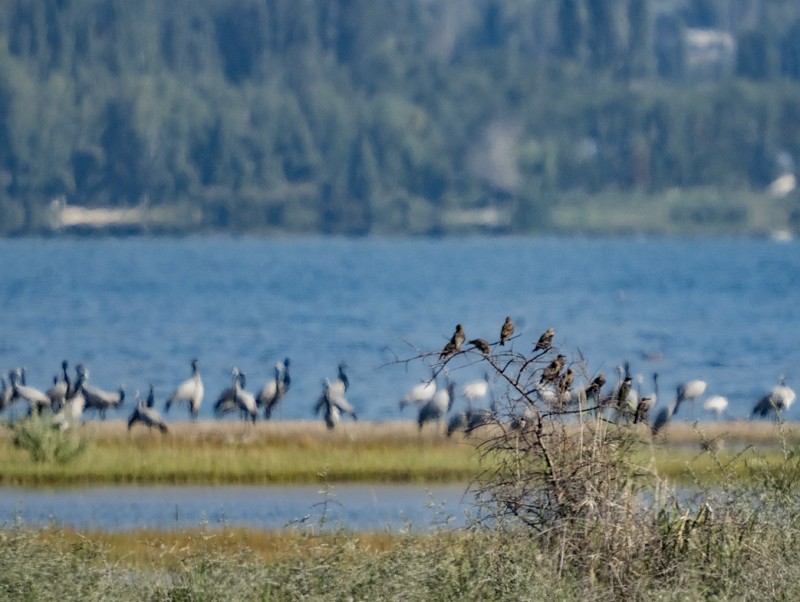
Nearly 7,000 birds were recorded during field observations in the proposed "Kushtar" micro-reserve in the Issyk-Kul oblast. Specialists identified 31 species, three of which are listed in the Red Data Book of the Kyrgyz Republic: the Demoiselle Crane, the Whooper Swan, and the Glossy Ibis, according to the PF "CAMP Alatoo."
The collected data confirms the site's crucial role as a wetland bird habitat and a vital stopover for migratory species.
Of note, the proposed "Kushtar" micro-reserve was established in 2023 on the initiative of residents from Yntymak village in the Tyup District in collaboration with PF "CAMP Alatoo" to protect the habitat of 138 bird species. Spanning 98 hectares, the reserve includes a coastal zone of Lake Issyk-Kul.
The observations took place during Bird Fest 2026, an annual festival organized by the PF "CAMP Alatoo" in Yntymak village. Held for the third time this year, the festival brought together nature enthusiasts, school ornithological clubs, professional ornithologists, scientists from the Institute of Biology of the National Academy of Sciences of the Kyrgyz Republic, and local community members.
According to ornithologist and birdwatching specialist Azamat Khasenov, "the majority of the observed flocks consisted of the Ruddy Shelduck (Tadorna ferruginea)." In addition, specialists recorded Mute Swans, Whooper Swans, Demoiselle Cranes, Northern Lapwings, Great Cormorants, Greylag Geese, Great Crested Grebes, Little Ringed Plovers, Common Redshanks, Grey Herons, Mallards, and other species.
"The bird ringing results were of particular scientific interest. Observations showed that the 'Kushtar' area serves as a migratory stopover for several passerine species, including the Lesser Whitethroat, Greater Whitethroat, Bluethroat, Common Chiffchaff, and Greenish Warbler. This highlights the importance of the Issyk-Kul coastline not only for waterbirds and waders, but also for migratory songbirds using the area as a transit zone," the report states.
It is noted that the proposed "Kushtar" micro-reserve encompasses diverse habitat types—coastal sections, open water, reed beds, and terrestrial biotopes. This ecological combination creates ideal conditions for rich avian biodiversity and makes the territory critical for seasonal bird movements.
According to the organizers, experiencing this biodiversity firsthand was a key highlight of Bird Fest. Around 50 participants and guests joined ornithologists in the field to observe birds, learn species identification skills, and gain insights into their behavior, biology, and migration patterns.
Bird Fest is designed not as a traditional environmental action, but as an educational platform built around "edutainment"—where new knowledge is gained through engaging activities, games, workshops, and creative arts.
Participants learned about the bird ringing process and its scientific importance, took part in wildlife photography workshops, and tried hands-on felt crafting. Children and adults engaged in ornithological quizzes and feeder-making sessions. The program also featured discussions on preserving Issyk-Kul's biodiversity and screenings of environmental films.
"The main idea unifying Bird Fest is the opportunity to see nature not as something distant, but as an integral part of our daily lives. By observing birds, people begin to better understand how vital it is to protect the habitats that sustain them," noted specialists from PF "CAMP Alatoo."
The organizers intend to continue developing Bird Fest as a permanent platform for environmental education, promoting birdwatching, and advancing sustainable tourism in Issyk-Kul. Key priorities include strengthening partnerships with ornithologists and scientists, engaging youth and local communities in conservation efforts, and driving new regional biodiversity initiatives.
This material was prepared within the framework of the project "Restoring Ecological Connectivity for Ungulates in the Ala-Too Mountains," supported by the Sigrid Rausing Trust. The activities for the development and conservation of the proposed micro-reserve territory are carried out under the project "Conservation of Biodiversity in Tyup Bay and Development of Birdwatching," implemented by the NGO "Kushtar." Launched in 2022, COMDEKS Phase 4 is funded by the Ministry of the Environment of Japan and the Keidanren Nature Conservation Fund (KNCF), and implemented through the GEF Small Grants Programme (SGP) at UNDP.
Source: Kaktus Media https://kaktus.media/doc/552955_krasnoknijnye_i_pereletnye._posmotrite_kakih_ptic_zametili_na_issyk_kyle_foto.html

Итоги пастбищного сезона 2018 года были подведены на очередном заседании районной пастбищной комиссии (РПК).
More
The development of the unified method, "Monitoring Pastures at the Local Level," is nearing completion.
More
Четыре новых моста построены в 2018 году в Кыргызстане при поддержке ОФ “CAMP Алатоо” и Швейцарской ассоциации “Памирские...
More